






Casto Cañavate explains how the focus is changing from simple energy efficiency to strategies for a sustainable world through digitalisation and energy management using KNX.
There has definitely
been a positive change in people’s approach to being more energy efficient and sustainable.
Thirty years ago, these issues were nowhere on the agenda. A decade later, those
in the commercial sector especially, began to realise how energy efficiency could
reduce their bills. But it is only recently that using less energy and being greener
has become an important issue for everyone, and even then, the two concepts are
not always linked. How many times do we still see an empty office building all
lit up after working hours, or an empty home using the heating system whilst
the family is away?
Passive measures
to save energy
Today, there
are some obvious passive measures that can be taken to save energy in a home or
building that can be implemented easily. Where possible, the bioclimatic
aspects in the design phase of the construction should be considered, so that
the building is orientated to benefit from the right amount of natural light, natural
ventilation, etc. Using the right materials can offer not only sound
insulation, but protection from extreme thermal fluctuations, reducing the need
for additional heating or cooling. And even after the construction is complete,
consumables such a lightbulbs can be replaced by energy-saving LEDs, and timers
can be used to control heating systems.
Active
measures to save energy
Active
measures can also be taken to increase energy savings, drastically. For
instance, whereas traditional thermostats automate heating and cooling
activation based on room temperature, modern thermostats use smart technologies
to add a whole new set of features to guarantee energy savings, such as
integrated sensors that turn the system off and on based on movement in the
home or office. Likewise, smart devices can be used to activate ventilation,
lighting and other room functions as well as heating, according to the use of
the room and external conditions.
The
combination of such measures can increase the energy efficiency of buildings
significantly, but there is still a need for a change to a more sustainable
world, which cannot be achieved through energy-efficient projects alone. We
need to move to the next level: energy management with KNX.
Global digitalisation
According to
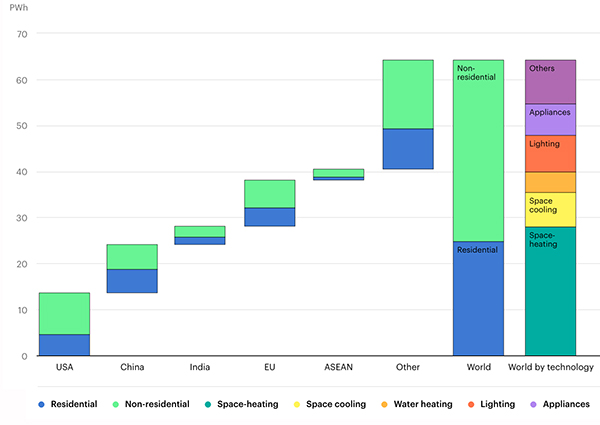
the IEA (International Energy Agency), buildings account for nearly one-third
of global final energy consumption and 55% of global electricity demand.
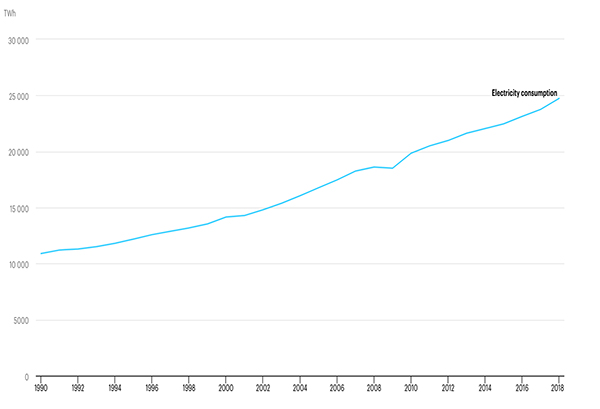
Electricity demand growth in buildings has been particularly rapid over the
last 25 years, accounting for nearly 60% of total growth in global electricity
consumption. In some rapidly-emerging economies, including China and India,
electricity demand in buildings grew on average by more than 8% per year over
the last decade.
The IEA’s Digitalisation and Energy technology report (IEA (2017), Digitalisation and Energy, IEA, Paris) states that electricity use in buildings is set to nearly double from 11PWh (petawatt hours, where 1PWh = 1015 watts = 1,000,000,000,000,000 watts) in 2014 to around 20PWh in 2040, requiring large increases in power generation and network capacity. Digitalisation, including smart thermostats and smart lighting, could cut total energy use in residential and commercial buildings between 2017 and 2040 by as much as 10%. Cumulative energy savings over the period to 2040 would amount to 65PWh – equal to the total final energy consumed in non-OECD countries in 2015.
Energy management
with KNX
Energy
management using KNX allows a system to supply uninterrupted energy according
to the needs of users at any given time. This same system can also decide what is
the best thing to do with the energy in the home or building, starting from its
generation through to whether it should be consumed or stored, according to the
key parameters of being efficient and preferring energy from renewable sources.
KNX
has a lot of experience in energy management applications. For instance:
- KNX
can control heating production, as well as monitor air-conditioning and heat
pumps units. - KNX
provides individual room control of cooling or heating - one of the applications
in which KNX has been very successful. - In
recent years, the KNX system has been able to connect to metering and
submetering, providing data for specific parts of the installation up to the
overall energy consumption of the system. - For
load management, KNX can ensure that the level of the load stays between given limits. - KNX
can be connected to single- and three-phase meters digital smart meters, with
all the possibilities this brings. - Many
different types of load can be integrated with a KNX system, such as hot water
production, heat pump via smart grid, etc.
More
recently, KNX has been extended with new application domains that are expected
to grow in the near future:
- Energy
storage monitoring with bidirectional information flow to/from KNX. - Connecting
charging stations to KNX to indicate if the charging station is occupied or
free, display the charging progress, set charging limits in terms of time or
power, report errors, and communicate securely thanks to KNX Secure technology. - Stabilisation
of the smart grid. KNX can help the grid to be smart when it cannot meet the
energy demands of connected homes and buildings.
Conclusion
The pace of digitalisation in the energy sector is increasing, resulting in improved safety, productivity, accessibility, and sustainability of energy systems. In addition, public awareness of living in a more sustainable world has increased in a way that it is changing markets, causing new business models to emerge. KNX is already working with this new reality, and offers an exciting range of energy management applications, devices and solutions. For more information on KNX and energy management, don’t miss our next article on this series of Energy Management with KNX!
Casto Cañavate is the Marketing Manager for KNX Association