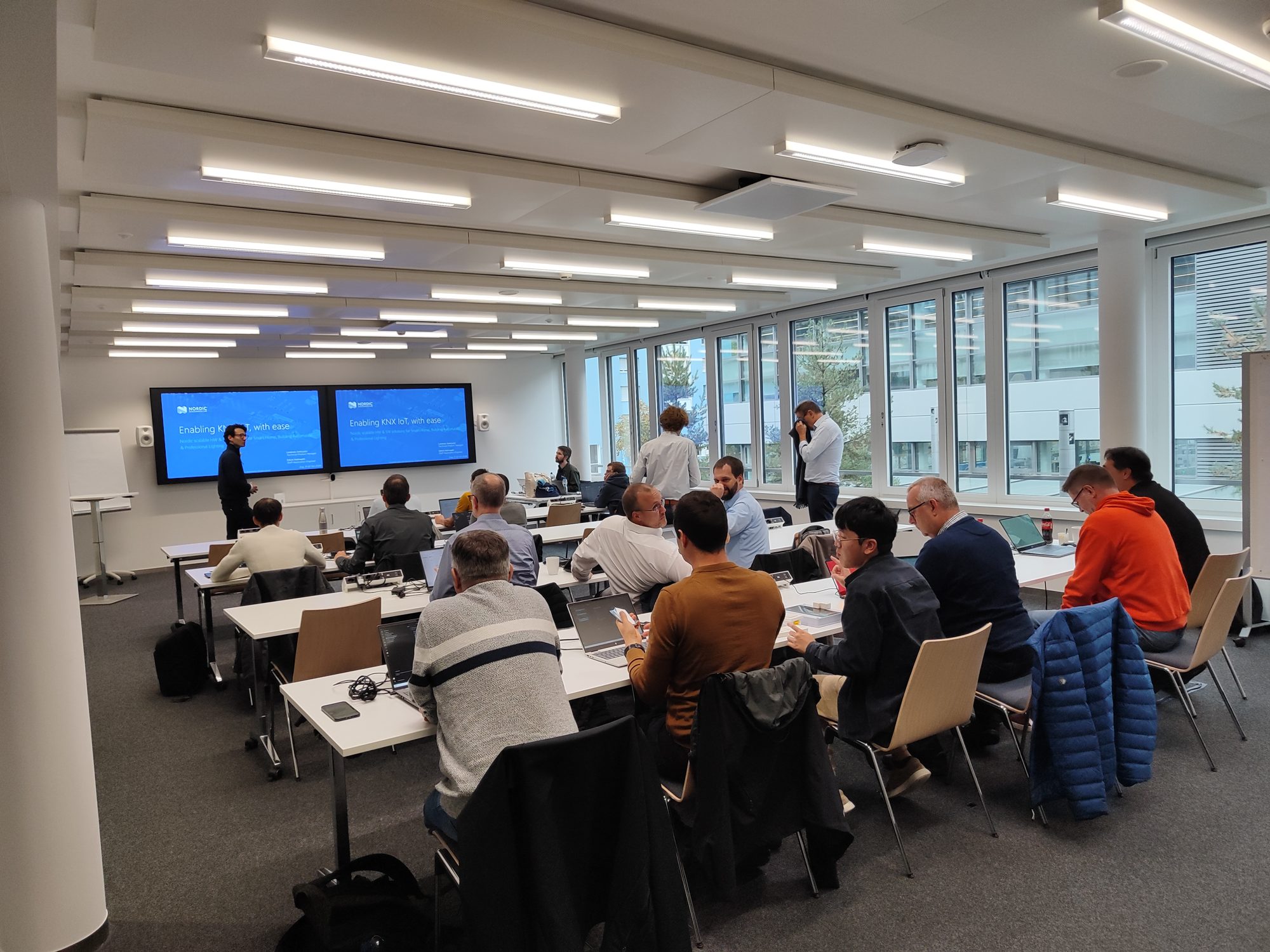









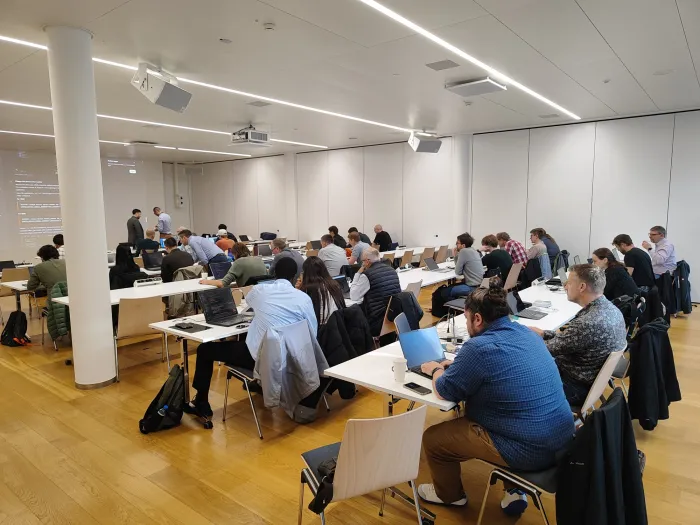
For years, discussion around KNX IoT has focused on what extending KNX onto IPv6-based networks could make possible. A two-day workshop attracting more than 50 participants and held at Siemens Switzerland in Zug in October shifted the emphasis firmly toward doing.
For Jesús Arias, Membership & Business Development at KNX Association and the organiser of the workshop, the significance of Zug went beyond the hands-on format. Giving manufacturers the opportunity to work directly with the technology provided tangible evidence of a much broader shift taking place within KNX. “In my opinion, KNX IoT is probably the biggest breakthrough in KNX technology since KNX was invented,” says Arias. “It expands KNX fully into IP and opens the ecosystem to technologies and developers we haven’t traditionally reached.”
From slides to hands-on development
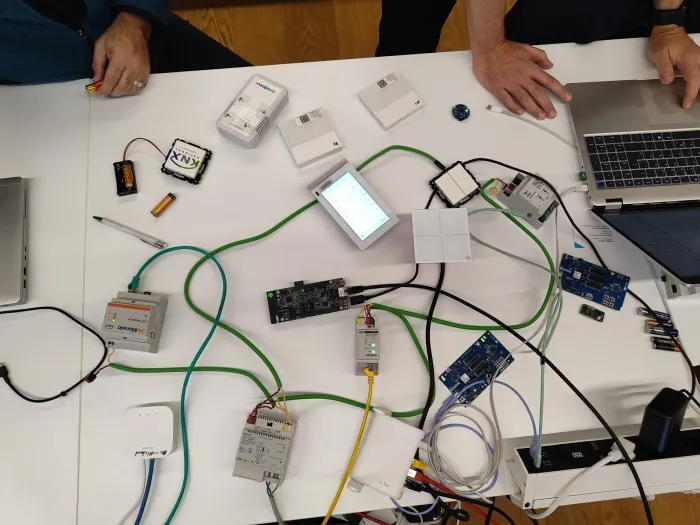
The workshop was designed to cover the KNX IoT development chain, from the KNX IoT Open Source Stack and an overview of available devices through to the Zephyr open-source platform, certification and the use of KNX IoT within ETS.
Participants could also work directly with evaluation boards from semiconductor manufacturers NXP and Nordic Semiconductor.
Zug was the first workshop at which KNX manufacturers gathered specifically to experience the new ecosystem hands-on, Arias explains. Developers could build prototypes, experiment with the open-source tools and then bring what they had created into a wider KNX environment.
The resulting test setup became what KNX Association describes as its largest KNX IoT integration to date. It combined KNX Twisted Pair devices and KNXnet/IP equipment with certified KNX IoT devices from Siemens, Cascoda and ATOUCH running on Thread, as well as the Allorado KNX IoT Router.
Alongside this established equipment, a side plugfest allowed participants to connect their own prototypes running on Thread and Ethernet. Devices built using NXP and Nordic Semiconductor platforms were programmed through ETS using prototype application programs. The significance was not simply that the individual technologies worked, but that they could be brought together within the same KNX environment.
Interoperability has always been fundamental to KNX. The Zug setup offered developers the opportunity to test how that principle carries across into KNX IoT when established KNX technologies are combined with IP-based networks, new hardware platforms and devices from multiple manufacturers.
For Arias, what made Zug particularly important was that it moved KNX IoT beyond presentations and demonstrations. “This was hands-on,” he says. “Manufacturers could experience the ecosystem, prototype with it and learn how the open-source environment works.”
Familiar foundations, new skills
For established KNX professionals, the transition to KNX IoT should not mean abandoning the tools and principles they already know. Arias identifies three elements that remain central: application-level interoperability, ETS and certification.
The differences come at network level. IPv6, Ethernet, Wi-Fi and Thread introduce concepts that may be less familiar to professionals whose experience has primarily centred on KNX Twisted Pair or existing KNX IP installations. Onboarding devices onto Thread networks is one example. Understanding IP networking will inevitably become more important too. Arias does not see that as a fundamental change in what it means to work with KNX, but as an expansion of the skills surrounding it.
The development environment is changing as well. Zephyr, the open-source real-time operating system supported by the Linux Foundation, formed part of the workshop programme.
Arias is not a software developer himself but says he was able to set up the development environment and flash an evaluation board in less than three hours. While that does not make device development simple, it illustrates how open-source tools and ready-made semiconductor platforms can lower some of the barriers to experimentation and prototyping.
That is particularly significant for manufacturers. Rather than having to create every part of a KNX IoT implementation from the ground up, developers can work from existing stacks and hardware platforms and concentrate more of their effort on the device and its application.
Moving towards products
The next test for KNX IoT is whether that development activity translates into products that integrators can specify and install. There are already signs of movement. Certified KNX IoT devices were part of the Zug test environment, while major semiconductor companies are developing system platforms around KNX IoT.
KNX Association also says manufacturers are working on products in areas including energy management and smart metering over Ethernet. Arias is cautious about predicting which product categories will emerge first, arguing that those decisions ultimately belong to individual manufacturers. But he believes the surrounding ecosystem is now in place for a broader range of products to follow.
The next steps are therefore focused on helping developers turn experimentation into working devices. KNX Association plans to develop an online webinar format based on the Zug workshop, working with semiconductor partners including NXP and Nordic Semiconductor. A dedicated KNX IoT Plugfest is also planned for 2027.
For Arias, the plugfest is a natural progression. Manufacturers have now had an opportunity to learn the development process and work with the technology; the next stage is to bring their prototypes together and test them against one another.
Extending the ecosystem
KNX IoT does not replace the technologies already deployed across KNX installations. Instead, it extends the environments in which KNX devices can be developed and connected.
Thread, Wi-Fi and Ethernet are already widely used across IT, consumer and IoT markets. Bringing KNX application-level interoperability, ETS engineering and certification into those environments potentially opens the standard to manufacturers, developers and applications that have traditionally been more comfortable working with IP technologies.
The important outcome from Zug was therefore not simply that more than 50 developers attended a successful workshop. It was that established KNX devices, certified KNX IoT products and new prototypes could be brought into the same working environment, configured through familiar tools and tested together. That’s evidence that KNX IoT is no longer simply a future direction, but an ecosystem manufacturers can now begin building on.