









By Simon Buddle, Future Ready Homes.
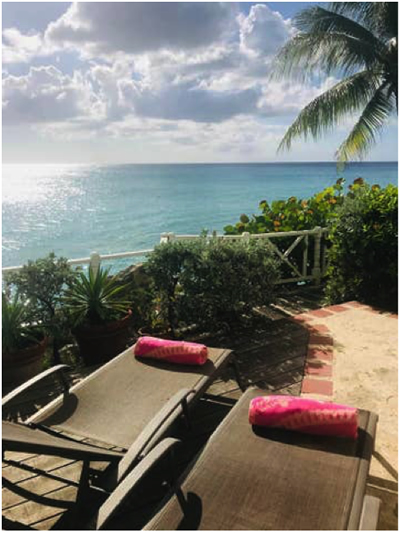
I'm not one for sun worshipping nor am I usually in need of some winter sun. However, this year we're heading to see friends and family in New Orleans and thought we might stop off for a week in Barbados. Well, it's been a long year and we can do with a break. So, if you're reading this in late December, it's likely that I'll be lying on that sun lounger with a rum in hand, soaking up some rays. After the rain and cold it'll be a welcome relief. In fact my daughter's office is so cold, due to the constant opening and closing of doors, that she's taken her hot water bottle and keeps it on her lap.
The human condition is unique to you and you alone. Each
person's senses are different; we smell, taste and feel uniquely. One person's
hot is another person's cold. If you spend all day in a chair, it's likely that
you'll feel cold even when it's 20oC, and conversely, if you are
doing hard physical work, you'll be feeling extremely hot. But the temperature
is only part of the story. Humidity has a huge part to play in how we feel
temperature and how comfortable we are in the environment we live in. Condensation
on the inside of windows or on walls will eventually damage property and may
lead to ill health.
Humidity
So, what is humidity? Well it is water vapour in the air,
right? Well, yes, but there are three different measurements of humidity.
Absolute
humidity is a measure of the actual amount of water vapour in the
air (units are grams of water vapour per cubic metre volume of air), regardless
of the air's temperature.
Relative
humidity, expressed as a percent, is a measure of the amount of
water vapour that air is holding compared to the amount it can hold at a
specific temperature. As temperature rises air expands this means that it can
hold more water vapour. As temperature falls so the air contracts leaving less
space for water vapour.
Specific
humidity refers to the weight of water vapour contained in a unit
weight (amount) of air (expressed as grams of water vapour per kilogram of
air).
Absolute and specific humidity are quite similar and are not
hugely useful to us. High humidity will prevent our sweat from evaporating
which, in turn, makes us feel warmer. Low humidity can cause static, dry skin,
sore throats, wood floors to split or paint to crack, amongst other things.
Temperature
For the purposes of humidity, we need to understand two
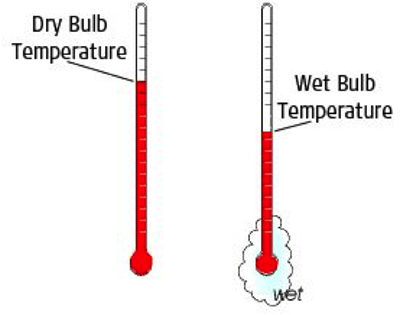
different temperature measurements; dry bulb and wet bulb. Dry bulb temperature
is simply the ambient air temperature. The wet bulb derives its name from the
bulb being wrapped in a wet muslin cloth. The rate of evaporation from the wet
muslin cloth on the bulb, and the temperature difference between the dry bulb
and wet bulb, depends on the humidity of the air. The evaporation from the wet
muslin is reduced when air contains more water vapour.
Dew point
So why is humidity important to us as KNX installers? Well
very simply; we need to know the dew point. This is the point at which the air
is fully saturated with water (100% relative humidity) and will begin to form
water droplets (condensation) on objects.
Cooling
If we are cooling down a room then the temperature of the
cooling must be considered to prevent condensation forming, for example on the
AC grilles, surrounding wall area, ducts or on chilled ceiling panels. As an
example, look at the graph below and you will see that for 100% saturation at
30oC, we have a dew point of 23oC.
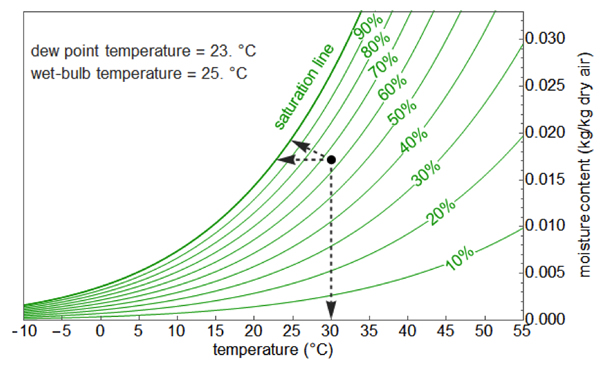
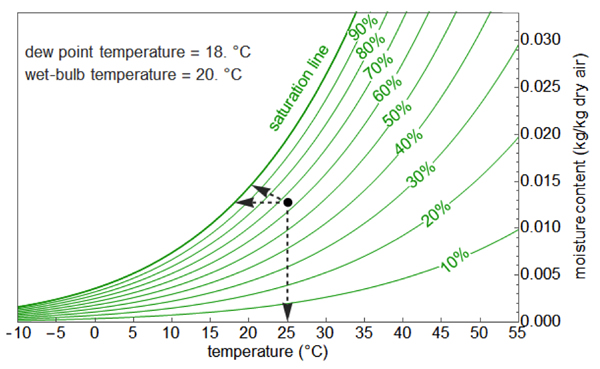
If you start blowing 18oC cooled air into the room, it is likely that condensation will form on surfaces that are being subjected to that temperature constantly. But as the air temperature lowers to 25oC we also see the dew point drop to 18oC. So, this requires some logic in our system to enable us to lower the chilled air or water temperature down gradually to ensure that we keep it above the dew point.
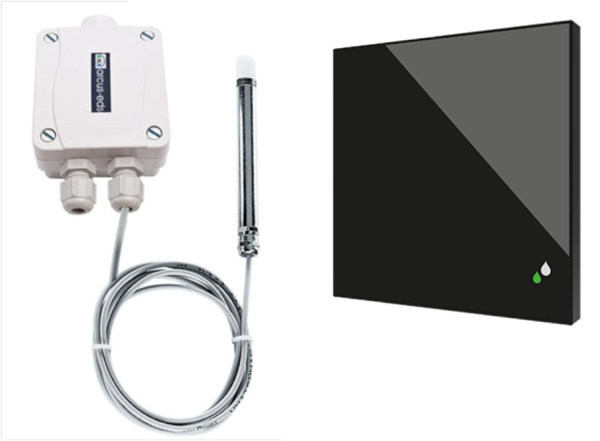
Better still, why not install a humidity/dew point sensor so that you can use the dew point temperature to derive the chilled air temperature? That way you'll never have a problem with condensation and no dripping ducts or ceilings. Indeed Zennio and Arcus both have devices that can provide temperature, humidity and dew point values for you. This is certainly worth considering if you want to avoid receiving a potentially large bill for ruined decorations.
Conclusion
Humidity has a role to play in our world, and if we can
measure it and the dew point, we'll be better placed to control the customer's
environment more intelligently, ensuring nothing gets damaged along the way. As
a minimum, understanding the science and being able to discuss the issue with
specifiers, designers and/or customers will surely help to differentiate us
from the rest of the pack.
That's it from me for this year. Have a wonderful seasonal break and I'll see you all in 2020. In case you're wondering, in Barbados the humidity will be around 75% with an average temperature of 30oC and a dew point of 25oC. Lovely!
Simon Buddle CEng MIET, is a consultant for Future Ready Homes, a specialist in BMS and ELV services system design.