









World Environmental Health Day on 26 September 2026 is centred on the theme “Environmental Health: Standing with Science to Protect Communities”. For KNX professionals, indoor air quality is a very practical example of what that can mean in a building: measure the conditions, understand what the data is telling you and let the building respond accordingly.
Every year on 26 September, World Environmental Health Day puts a spotlight on the connection between our surroundings and our health. This year's theme, “Environmental Health: Standing with Science to Protect Communities”, feels particularly relevant to the buildings in which we spend so much of our time. For KNX professionals, there is a very practical interpretation of that message.
Don't guess what is happening inside a room. Measure it.
Most installers have walked into a meeting room and immediately known that the air isn't quite right. The room is warm, every chair is occupied and somebody has eventually opened a window because it feels stuffy. Ten minutes later, the temperature has dropped, the heating or cooling is still running and half the people in the room are now uncomfortable.
Not exactly intelligent building control.
Indoor air quality is one of those building functions that occupants tend not to think about until something feels wrong. Yet CO₂, humidity, temperature and occupancy can all provide useful information about what is actually happening in a space. Once that information is available, ventilation can respond to real conditions rather than relying only on fixed schedules or somebody remembering to open a window.
CO₂ Gives Us Something We Can Measure
|
Image

|
One of the most useful measurements for demand-controlled ventilation in an occupied room is CO₂. People produce carbon dioxide simply by breathing, so concentrations tend to rise as occupancy increases when there is insufficient fresh-air exchange. That makes CO₂ a useful indicator of whether ventilation is keeping pace with the number of people using a space. A classroom provides a good example. Empty at 07:30, it may need very little ventilation. Put 25 pupils and a teacher into the same room at 09:00 and conditions change quickly. Running the ventilation at maximum output throughout the entire day would solve one problem, but potentially create others: unnecessary fan energy, additional heating or cooling demand and, depending on the system, more noise. Demand-controlled ventilation takes a different approach. KNX air-quality sensors can measure CO₂ alongside parameters such as temperature and relative humidity. That information can then be used to increase ventilation when the room genuinely needs it and reduce it again when demand falls. Because these sensors are available from different manufacturers within the KNX ecosystem, the strategy can be built without locking a project into one vendor's sensor range or ventilation system. The principle is simple: ventilate according to measured need rather than assumption, helping avoid unnecessary ventilation and the energy use that comes with it. |
One Measurement Rarely Tells the Whole Story
CO₂ is useful, but it should not become the only figure we look at. Bathrooms, kitchens, changing rooms and other moisture-heavy spaces present a different challenge. Here, relative humidity may tell us more than occupancy alone. A bathroom could be empty and still require increased ventilation because somebody has just taken a shower. Equally, a busy meeting room might need more fresh air whilst relative humidity remains perfectly normal. Temperature adds another piece of information. So does presence. This is where combining measurements becomes useful. Depending on the room and application, a KNX control strategy can take CO₂, relative humidity, temperature and occupancy into account rather than making a decision from a single sensor value. Rather than asking whether the fan should simply be on or off, we can start asking how much ventilation the space actually needs.
Boost When It Matters
A very practical example is an MVHR system with a boost input or variable-speed control. In a bathroom, rising humidity can trigger boost mode. Once the humidity level has returned towards its normal range, ventilation can return to its standard operating state. In a meeting room, increasing CO₂ can raise the ventilation rate proportionally or in stages. When the occupants leave and conditions recover, airflow can reduce again. Presence detection adds another useful piece of context. An occupied room with rising CO₂ is a very different situation from an empty room where the values are already returning to normal. None of this requires particularly exotic automation. It simply requires useful measurements and sensible control logic.
From Feeling to Evidence
This is perhaps where the theme of this year's World Environmental Health Day becomes particularly relevant. Indoor environmental conditions are often discussed subjectively.
“The room feels stuffy.”
“The ventilation isn't working properly.”
“It is always too humid in here.”
Those observations may be perfectly valid, but they do not tell the installer what is actually happening. Trend data does. Being able to review CO₂, relative humidity and temperature over time can transform the conversation. Perhaps the meeting room consistently reaches high CO₂ levels every afternoon. Perhaps the bathroom takes far longer than expected to recover after use. Perhaps the ventilation system is already operating at maximum output whilst indoor conditions continue to deteriorate.
Now there is something to investigate.
For system integrators, monitoring turns a vague comfort complaint into measurable information that can be used to investigate how the building is performing — and into something reassuring to hand back to the customer. Peace of mind, in this context, is simply being able to show somebody what is actually happening in their building rather than asking them to trust a feeling.
Watch the Thresholds
There is a temptation with air-quality control to find one magic CO₂ figure and programme everything around it. Real projects deserve a little more thought.
Target values and ventilation requirements depend on the building type, occupancy, local requirements and the ventilation design itself. The KNX system should support that design rather than inventing its own ventilation strategy after the mechanical contractor has left site. For the system integrator, this means getting the right information early. What airflow rates can the ventilation unit provide? Can it accept stepped commands, a 0–10 V signal or communication through a gateway? What target values have been defined by the HVAC designer? How quickly should the system respond? Those conversations are much easier to have during design and commissioning than after somebody complains that the meeting room is permanently noisy.
Humidity Protects More Than Comfort
Indoor environmental quality is not only about whether the occupants feel comfortable. Moisture matters to the building itself. Persistent excess humidity and condensation can contribute to dampness and mould growth. In spaces where this is a risk, monitoring relative humidity provides an opportunity to react before the problem becomes visible.
For KNX professionals, the control logic can be relatively straightforward. Humidity sensors can trigger ventilation boost in bathrooms, utility rooms and other vulnerable spaces. Where appropriate, temperature and humidity information can also be used to calculate dew point and help avoid condensation. The important point is that the system is responding to measured conditions rather than waiting for the consequences. Nobody wants the first indication of a humidity problem to be black marks appearing around a window frame.
Don't Forget What Is Happening Outside
Indoor conditions are only half of the picture. Opening motorised windows in response to elevated CO₂ may be an effective strategy on a mild day. It becomes a rather less intelligent one during heavy rain, extreme outdoor temperatures or when outdoor conditions make natural ventilation unsuitable. This is where integration with the wider KNX installation becomes useful. Outdoor temperature, weather information and window status can all contribute to the control logic. Mechanical ventilation, automated windows, shading and heating or cooling should work as parts of the same building rather than making contradictory decisions. If the cooling is working hard whilst an automatically controlled window is wide open, something has gone wrong somewhere in the control philosophy.
Make the Data Useful
|
Image
|
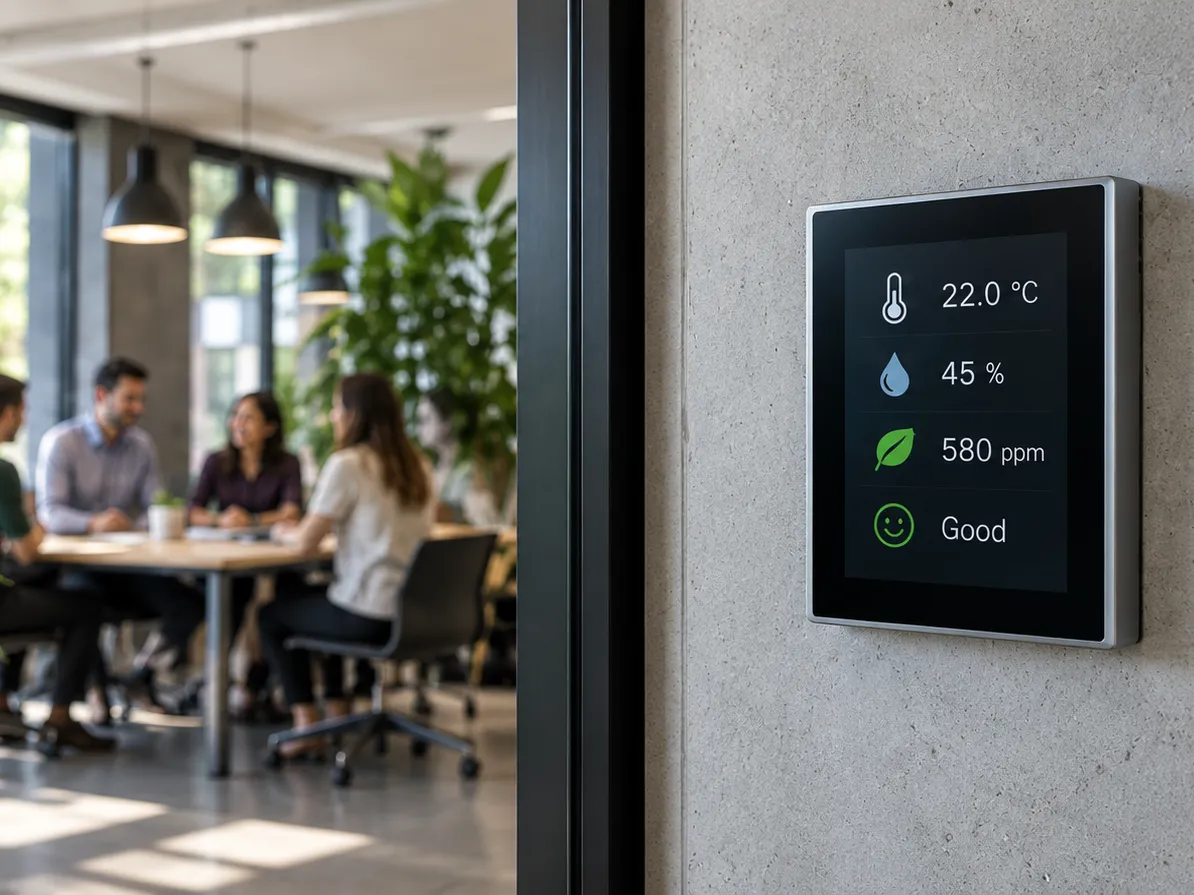
There is little value in collecting information simply because we can. The installer needs to decide what happens to it. Some values are useful for automatic control. Others are helpful during commissioning or maintenance. Certain conditions may justify a warning or notification, whilst ordinary fluctuations do not need to bother the customer at all. Good visualisation can be particularly useful during commissioning. Seeing CO₂, temperature and humidity trends makes it much easier to verify whether the ventilation strategy is behaving as expected and whether problem rooms are emerging. The objective is not to create another dashboard full of numbers for the sake of it. It is to turn measurements into useful decisions - and, over time, into an ongoing conversation with the customer rather than a box ticked at handover. Thresholds that made sense when a building was commissioned may need revisiting as occupancy patterns, room use or even the climate itself changes. That kind of review also gives KNX professionals an opportunity to continue supporting and optimising the building long after the initial installation |
A Useful Commissioning Checklist
When integrating indoor-air-quality control into a KNX project, it is worth checking:
• Which parameters actually matter in each space: CO₂, humidity, temperature, presence or a combination?
• Are the sensors positioned where they will provide representative measurements?
• What operating modes and control inputs does the ventilation system support?
• Have the required thresholds and target values been agreed with the HVAC designer?
• Does the control use suitable hysteresis or delays to avoid constant switching?
• What happens when a room becomes unoccupied?
• Are heating, cooling, window control and ventilation coordinated rather than working against one another?
• Can relevant values and trends be monitored during commissioning and later maintenance?
• Which conditions genuinely require an alarm or notification, and which should simply be handled automatically?
None of these questions is particularly difficult. Missing one or two of them, however, can turn a perfectly good ventilation system into an irritating one.
Conclusion
World Environmental Health Day is a useful reminder that the quality of our indoor environment deserves the same attention as many of the building functions we can see. For KNX professionals, the practical lesson is not complicated: measure first, then control. CO₂, humidity, temperature and occupancy provide evidence of how a space is actually being used. By connecting those measurements with ventilation, heating, cooling, windows and shading through a single open platform, KNX can help the building respond to real conditions rather than assumptions - drawing on certified products from more than 500 manufacturers rather than relying on a single closed system.
That is where building automation can make a tangible contribution to indoor environmental quality: not by adding more technology for its own sake, but by turning reliable information into better decisions and giving KNX professionals the tools to keep building performance under review over time. Sometimes the smartest function in the room is the one nobody notices working.