










Michael Bendtsen outlines the different types of KNX group address structures and the best practices to be used when designing, planning and configuring KNX system installations.
In order
to be an efficient KNX programmer and to make KNX projects run smoothly from
start to finish, you need to think about how you are going to configure and
document your KNX group address (GA) structures during the design and planning
stages of the installation.

Some of
the most common problems associated with KNX installations and ETS programming
arise from the following issues related to KNX group addresses:
- No clear overview or knowing where to find details in your KNX project.
- ETS programming is difficult and tedious when there is no clear KNX group address structure.
- KNX group addresses being poorly-structured makes debugging difficult.
- KNX group addresses being poorly-documented makes visualisation difficult.
- No descriptions or details given for KNX group addresses makes handovers difficult.
- Using fixed indexing and names for all projects makes it hard to scale the projects.
For
complication- and trouble-free programming in ETS, KNX group addresses should
be structured correctly, self-documented and easy to read and understand.
Different
types of KNX group address structure
Sometimes
you may need to have different types of GA structure in your arsenal, to suit different
types of KNX project. There is no 'magic' GA structure that is superior or
works better than the rest; the best GA structure is simply the one you know well
and feel comfortable using. However, there are pros and cons for each different
structure, which I will outline below.
We can
roughly segment the different GA structures into three main groups, namely function-based,
building-based and device-based.
- Function-based group address structure – this is generally promoted by the KNX Association.
- Building-based group address structure – this is mostly used in larger projects.
- Device-based group address structure – this is a less well-known variation of the function-based GA structure, but still worth a mention.
In
addition, there are many different variations of these groups.
To
simplify these group address principles, it is best to see them as only two
different parts:
- Main and Middle structure – which sets the frame of how we build everything up.
- Group addresses that are the same for all types of structure – which we can call a GA Set.
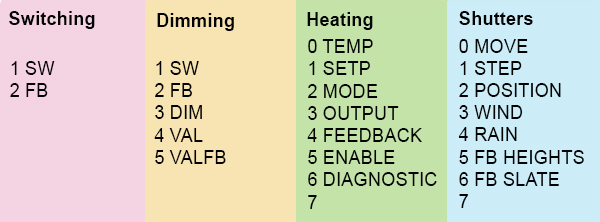
By separating the GA Set, it becomes clearer how the Main and Middle structure should be built. For example, if we have a 'Dimming' function, then we could have a GA Set for Dimming comprising the following 5 group addresses:
- SW (Switch)
- FB (Switch Feedback)
- DIM (Dimming)
- VAL (Value)
- VALFB (Value Feedback)
It does
not matter if we have a function-, building- or device-based structure, as we would
still have the same GA Set, as shown below.
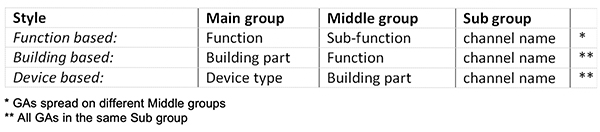
We can
also see the differences between the Main, Middle and Sub group in this matrix.
So, when adding your GA Sets to these different structures, you will have something which might look like this:
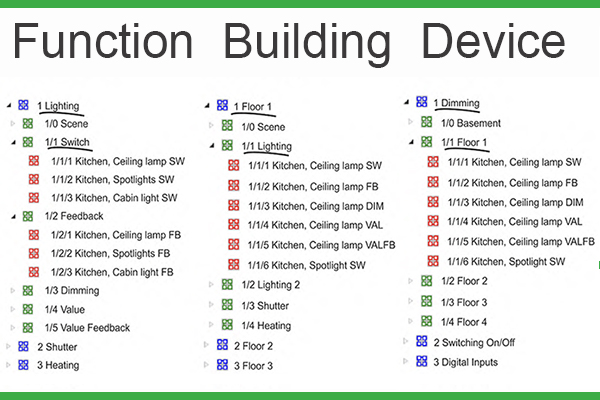
Note:it is important to understand the difference between a group address
structure and a group address set. If you do this separation, you can start to
define the group address set you prefer to use and then start to place it
inside your structure of choice.
Conclusion
Some of
the most common problems associated with KNX installations and ETS programming
arise from issues related to KNX group addresses, so the best practice is to adopt
an efficient approach by using an appropriate group address structure and organising
group addresses into sets that are the same for all types of structure. This
article serves as an introduction to this subject, and further reading is
recommended.
Michael
Bendtsen is the owner of electrical planning agency BEMI Automation, and an
accredited KNX Partner with over 15 years of experience working on both
commercial and residential KNX system installations.