








By Philip R. Juneau, ATC.
You may think the title bold, but based on all of the successful and sustainable installations worldwide, I'm quite comfortable and proud to state this. I must admit, for many years, I was unaware of the KNX technology being in the HVAC (i.e., BMS) controls industry, which operates mainly in a BACnet environment. However, after being exposed to the KNX protocol's functionality, I quickly realised its true power as a robust, reliable room/occupant-level controls protocol.
In this month's article, I want to compare what is being
traditionally done today and what the future of controls could look like here
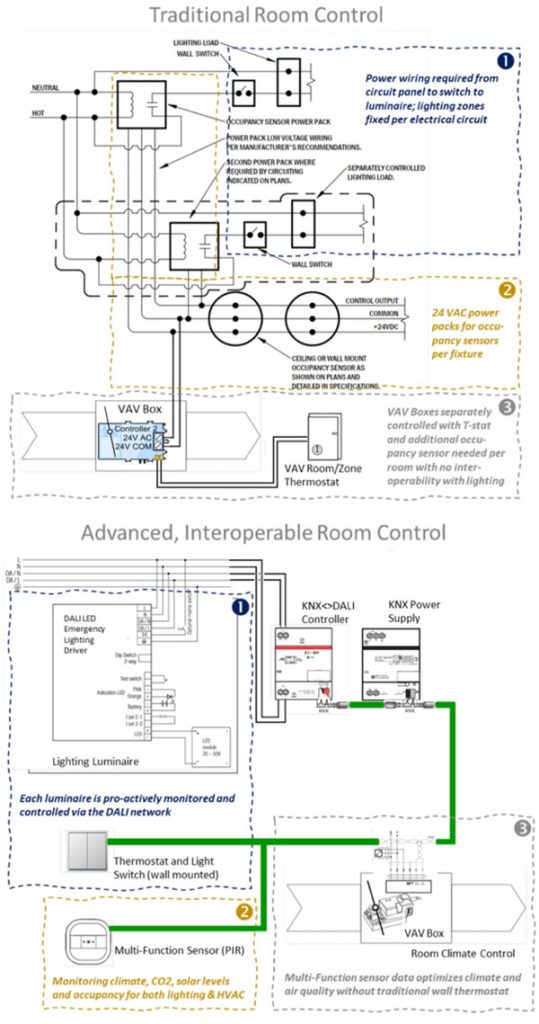
in the USA. Below is an illustration of traditional vs. KNX room-level control.
Zoning and detailed monitoring per luminaire
In traditional lighting systems, 120/277V power wiring is
required from the circuit panel to the switch and then to the luminaire, making
the lighting zones fixed for each installed electrical circuit. Hence, future
renovations will require existing electrical circuits and associated switches
and sensors to be modified. There is also zero transparency regarding the
lighting fixture and overall energy allocation.
With a KNX-DALI system, no power wiring is required to the
low-voltage intelligent switches/sensors, saving considerable material and
installation labour costs. Each luminaire can be proactively monitored and
controlled by the DALI network's ability to provide key operational data for
each luminaire, as each LED driver is a node on the DALI communication network.
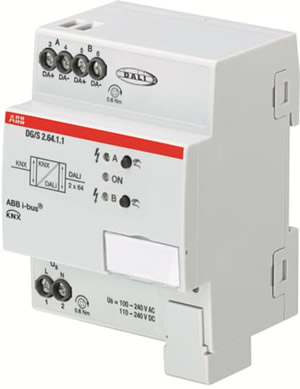
By integrating DALI into the KNX protocol via a KNX-DALI controller, we integrate
the DALI lighting data together with the KNX building system data to take
advantage of the KNX protocol's backbone functionality. This then allows us to,
for example, use diagnostic tools to determine the luminaire operational status
such as power, LED module/strip, LED driver status, light output, etc).
In other words, the KNX-DALI system revolutionises lighting
maintenance with a platform that provides a proactive, highly-transparent
monitoring and controlling regime.
Low-voltage sensors on a robust network
Traditional motion/occupancy sensors require 24V power packs
for each sensor, which involves significant installation labour and material
costs for conduits, wires, etc, on top of its own substantial cost. Also, these
motion sensors are only measuring occupant presence and are missing other key
room characteristics such as temperature, humidity, CO2, solar gain/loss, LED
lumen output, and LED driver amperage.
With the KNX-DALI system, all of these values come under one
umbrella. We can measure presence, climate and solar gain/loss from the
ceiling-mounted KNX multi-function sensor; temperature, humidity and CO2 from
the wall-mounted KNX room unit; and LED lumen output, amperage, etc from the
DALI LED drive.
By using low-voltage wiring and communication with these
room sensors on both lighting (including daylight) and HVAC, you can eliminate
considerable first installation costs as well as provide a future-proof
building control system using the open protocols of KNX and DALI.

Complete room control
With the traditional HVAC system, the control operation is
irrespective of the lighting or other adjacent systems. This is due to the
different trades in building construction industry being kept separate, which
is not always conducive to a holistic and integrated building operational
environment. In these cases, the room ventilation VAV (Variable Air Volume)
boxes are controlled separately with a thermostat and an additional (to the
lighting) occupancy sensor. This is redundant from a control perspective and,
quite frankly, a myopic view resulting in wasted money and time.
With the KNX-DALI system, room climate is truly
interoperable since the lighting and HVAC components are based on the same
standard! It's really that simple. Why have separate systems when you can
follow a longstanding, industry-leading standard for room occupancy? For the
other central automation and data exchange, BACnet is still the preferred
method and is very interoperable with KNX since both are ASHRAE standards.
Conclusion
With the KNX and DALI combination, I hope that I've shown that mastering room-level control cannot be more streamlined and straightforward. The mechanical and electrical trades can be united on the occupant level, where the greatest efficiencies are to be achieved. In addition, you will not be beholden to any one supplier or integrator, as there so many devices, tools and services available from multiple providers, making it a future-proof choice for your building controls.
Philip R. Juneau is the Chief Commercial Officer for Automated Technology Company (ATC), and Vice President of the KNX USA National Group. ATC's mission is to transform today's buildings into tomorrow's net-zero infrastructure by ensuring the highest levels of safety, comfort and efficiency for the overall well-being of its occupants and the overall environment.
Philip R. Juneau is the Chief Commercial Officer for Automated Technology Company (ATC), and Vice President of the KNX USA National Group. ATC's mission is to transform today's buildings into tomorrow's net-zero infrastructure by ensuring the highest levels of safety, comfort and efficiency for the overall well-being of its occupants and the overall environment.